A long-term project on the nature of art that took place in September 2013 at the Museo Nacional Centro de Arte Reina Sofía in Madrid.
One True Art - 16 Responses to the Question What Art is is a performative artistic experiment in which the aim is to come up with a definition of art or reflect on the reasons why this definition is impossible. The work is an invitation to reconsider the notion of art by looking at it from a series of simultaneous perspectives, ranging from the metaphysical to the political.
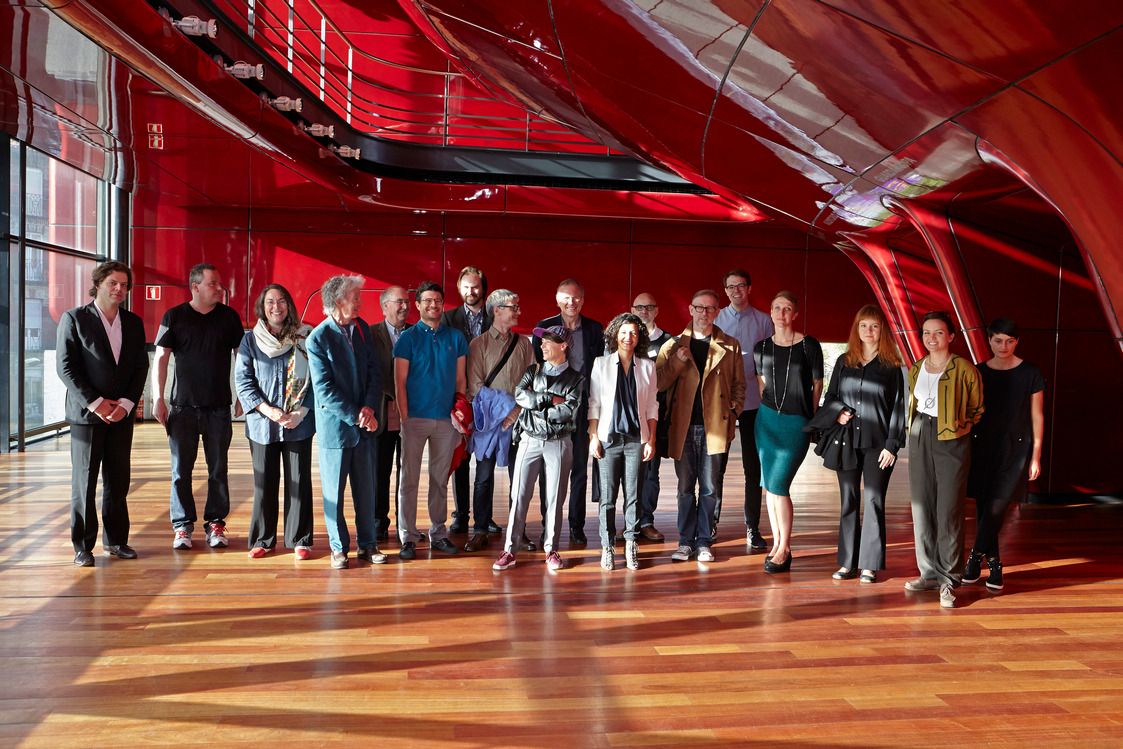
The central element in this project is a one-day public event specially conceived to focus attention on the issue of the nature and specificity of art. The event is intended to be an exceptional gathering of passionate minds all playing their part in seeing art from a slightly different angle. Sixteen art specialists,
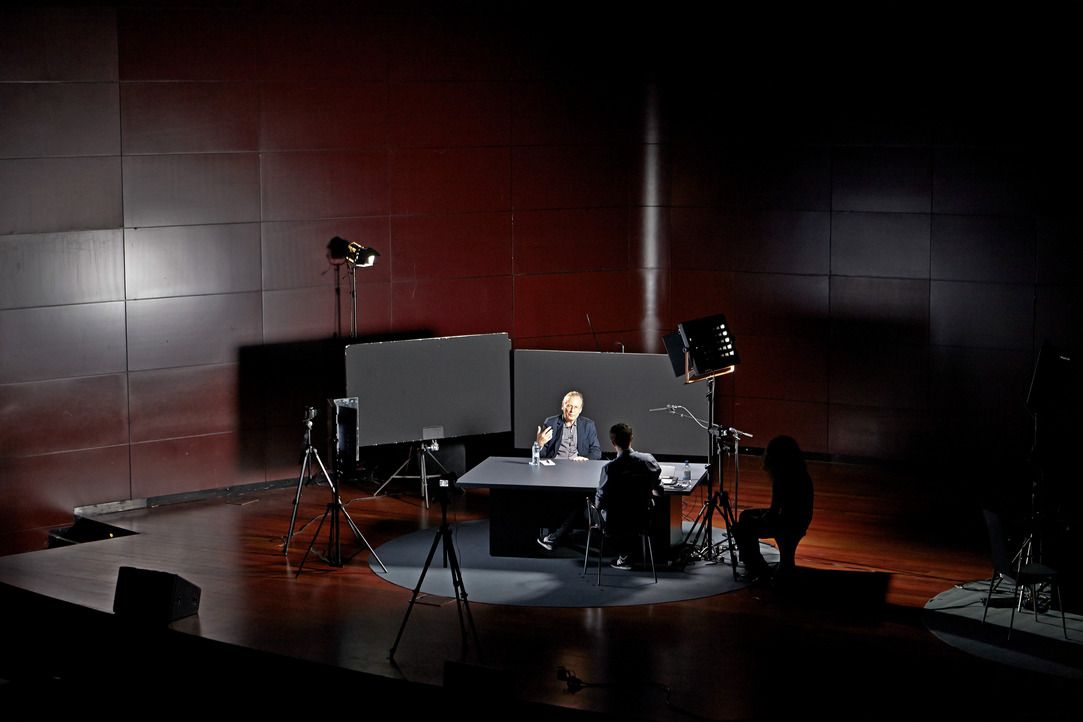
including philosophers, critics, curators and artists, have been invited to take part in a series of 30-minute interviews held in quick succession in front of an audience in the Museum auditorium. The topics to be covered, order of interviews and sequence of questions have been carefully prepared for one year.
Audiovisual material recorded during the event was screened from October 14th, 2013, until January 6th, 2014, in the auditorium of Sabatini Building.
Interviewees:
Pierre Alferi
Jesús Carrillo
Thierry de Duve
Adelita Husni-Bey
Alana Jelinek
David Maclagan
Chus Martínez
Renzo Martens
Asier Mendizabal
Christoph Menke
Lili Reynaud-Dewar
John Roberts
Dieter Roelstraete
Kerstin Stakemeier
Marcus Steinweg
Oxana Timofeeva
General considerations
One True Art: 16 answers to the question ‘What is art?’ is a performative artistic experiment inviting the spectator to reconsider the notion of art by simultaneously examining it from perspectives that range from the metaphysical to the political. The goal of the project is to formulate a definition of art or reflect on the reasons why such a definition is impossible.
The central component of the work is a public act comprising sixteen interviews, each of thirty minutes duration, with sixteen art experts – philosophers, critics, curators and artists – over the course of a single day in the Reina Sofía Museum in Madrid. This act will take place in English and be recorded on video. The audiovisual material resulting from this encounter is the principal element in the resulting exhibition.
Thinking about Art
Art is a specific occupation and its existence constitutes a singular answer to precise needs. To those of this opinion, the elimination of restrictions on the concept of art, its fusion with other disciplines, and the development of new artistic processes, themes and practices are only relevant to the extent that they favour – and contribute to make accessible – that for which art is specifically required. To discover whether those factors do indeed serve those functions requires an independent analysis of the relationship between art and each of these new proceedings.
Any definition of art is necessarily ephemeral and incomplete. A fixed definition is difficult because the evolution of forms and strategies is a constitutive characteristic of artistic practices. Definitions rely on elements that at any moment may become circumstantial rather than essential and vice versa. But this does not mean that, in the midst of such ‘indirection’, there is nothing that can accurately be termed, in however transitory a fashion, ‘art’ and differentiate itself as such from other things that are not art. When art meets the requirements of its own specificity, it can be identified by the response that it provides to particular needs and impulses that are satisfied by no other activity.
The development of art is not confined to the operation by which the accuracy of its definition is renewed; they stand in a relation of asynchronous mutual feedback and the entire existence of art is conditioned by this constant self-questioning. Art has constantly to be defined and that definition has constantly to be updated.
Economic, political and social motives have presided over the failure to update the definition of art and have tended to relegate those who keep that definition active to positions in society in which they cannot give expression to their updated definitions. This discourse is not accessible to the general public because conceptions of art imbued with interests alien to its specificity occupy the entire communal space of speculation and debate. In such hostile circumstances, even the most sincere efforts to think about art can be corrupted.
Updating the definition of art from an open and independent point of view thus becomes an indispensable requirement of any artistic activity worthy of the name.
One True Art
Because the need for redefinition is integral to it, the concept of ‘art’ is always uncertain, both in the sense that it is necessary again and again to remember what is being defined and because one must constantly be finding a new definition that is better tailored both to art and to any particular ‘moment’ in its unfolding strategies. What exacerbates the difficulty of conceiving a consistent idea of ‘art’ – an idea capable of encompassing all the variables in play at any given moment – is the fact that artistic no less than political, social and cultural experience has become fragmented on every level.
Art can only occur if it is in some measure embodied and consequently every artistic manifestation, as a body, presents itself to our judgement within a specific and inevitable context, a context that has not only been generated by that manifestation but in many respects forms part of it. But some of the props of this context are contingent, having come into being at the periphery of this manifestation and of its necessary context; their purpose is to integrate/legitimate it or, more precisely, to disarm and isolate it from other artistic manifestations whose properties might delegitimise it.
The ‘art’ institution provides a common space in which these heterogeneous contexts can exist side by side. The primary and immediate effect of art is to make these isolated nucleuses communicate. But in its institutional phase, it becomes a resistance that separates them by establishing specific rules of legitimation for different social, cultural, political and economic environments and by opening up an inexhaustible source of ‘special cases’.
One True Art refers to the aspiration to bring within the same terrain art-relationships that tend to become disconnected and in this way to provide for the immediate perception of these environments in time, space and (ideally) in experience. Art cannot be ‘one’ but its unity is indicated by its inability to identify itself in its own eyes or define itself – a condition that arises when, using every means available, it attempts to transcend itself.
While art’s constant need for definition is integral to the logic of its positive developments, the interrogation of its contextual contracts is undertaken with a view to countering a more negative tendency toward stagnation and institutionalisation.
Interviews
One condition for the appearance of a new form is a certain sense of order. Subsequently, during the process of the form’s development, this order imposes itself on the impulse that brought it forth and needed the said form and order for its very existence. The institution or institutionalisation of the form is what elicits and encourages standardisation or ‘the format’; it suggests themes and solutions. Thus fidelity to the impulse requires that artistic formats should not be used ‘correctly’, in accordance with the logic of their development; on the contrary, they must be thwarted and put to work in a mode other than that for which they were conceived.
Only formats subjected to this process and thereby diverted from their ordinary purpose can meet the need to define art and continually renew that definition. Even then, they do so in precarious and ephemeral fashion. Lectures, classes and roundtables fit so comfortably into the institution that their meaning seems at every step to have been choreographed, rerouted by an inertia that is almost impossible to combat towards well-trodden paths. An exceptional lecture is truly an exceptional thing.
The interview too has its own entropic conduct and tends to flow where it generates least friction. But determination on the part of the interviewer and the receptivity of the person interviewed can counter this tendency. The potential for reversing its own inertia is integral to the interview as to no other format. The interview is structurally generous with the interviewer, the interviewee and the public because it ascribes a clear and unique role to each of these in which they can expand and blossom. The task of preparation falls entirely on the interviewer, who, after extensive observation of the object of study, has refined certain instruments, certain precision formulae for freeing up the discourse – which will, of course, be one discourse among the many possible in these circumstances. The interviewees will naturally, during the interview, respond to the questions asked by a specific individual and will attempt to make themselves understood by that person. Interviewees encounter a framework in which what they know and what interests them can be expressed freely and vividly with no other restriction than the need to make themselves understood.
The interview is the right format for the purposes of One True Art because it allows a very precise focus on the object of study and affords interviewees the possibility of expressing ‘non-standard’, ‘outsider’ and ‘fuzzy’ perspectives without inhibition.
Intensity
The purpose of concentrating these efforts and ideas in time and space is to create juxtapositions and contrasts while at the same time, as far as possible, eliminating points irrelevant to the question at issue. The questions are designed to create conditions for the interviewees to express as directly as possible the specificity of their knowledge of art and, by extension, the specificity of the artistic act.
The hope is that everything that the interviewees say will resonate with what is said before and afterwards, that the terms used will infiltrate other discourses, and that the different ways of speaking about art will suggest a transitory common denominator: a common environment of thought. Rather than ‘transformers’ that convert the tensions implicit between different points of view, the aspiration is to create connections that place them in intimate contact and ‘bridge’ these transformers. For the same reason, only one language is used throughout the act despite the diverse origins of the interviewees and their ideas.
The intensity and the precision of the focus depend on all parameters being arranged so as to permit the most abstract experience possible while maintaining cohesion.
Genre
These and other similar conditions give rise to a ‘non-standard’ public act that combines the following genres:
- The temporal limitations and guidelines and the presence of cameras and lights bestow on the act an intimacy and seclusion like that of a television set or film ‘take’.
- The scenario and its relationship to the public and the videoing presented as a spectacle in its own right convert the act into theatre and bestow on it a character of representation.
- Its presence in the museum, the various levels on which it develops (encompassing interviews, filming and the presence of the public), and the synchronicity of space and time combine with its pronounced self-referential character to make the act into an artistic performance.
Singularity
The act presents a panorama of thought ranging from the metaphysical foundations of artistic creation to the role of art in the political and social domains. All aspects of the discussion will be considered from the point of view of art: that is, from the assumption that thinking about art explains political, economic, cultural and social issues rather than vice-versa.
Preparing the work involves dealing with the problems characteristic of any process over whose development no norms preside. Given the non-standard format, it may be that not only the potential interviewees but also a section of the public are unwilling to take part; the act may fail to elicit the resonance required or its intentions may be misunderstood. In the same way, invitations to take part in a work of art may provoke confusion, since acceptance would seem to require some degree of trust in the artist who proposes it. These difficulties and others of the same kind as yet unknown are taken on board as an integral part of the project. The success of One True Art can be gauged by the extent to which it produces something at least a little outside the norm.